CAPTURING STORIES IN IMAGES AND WORDS” 2025 – 2026 EDITION
Explore • Capture • Create • Share
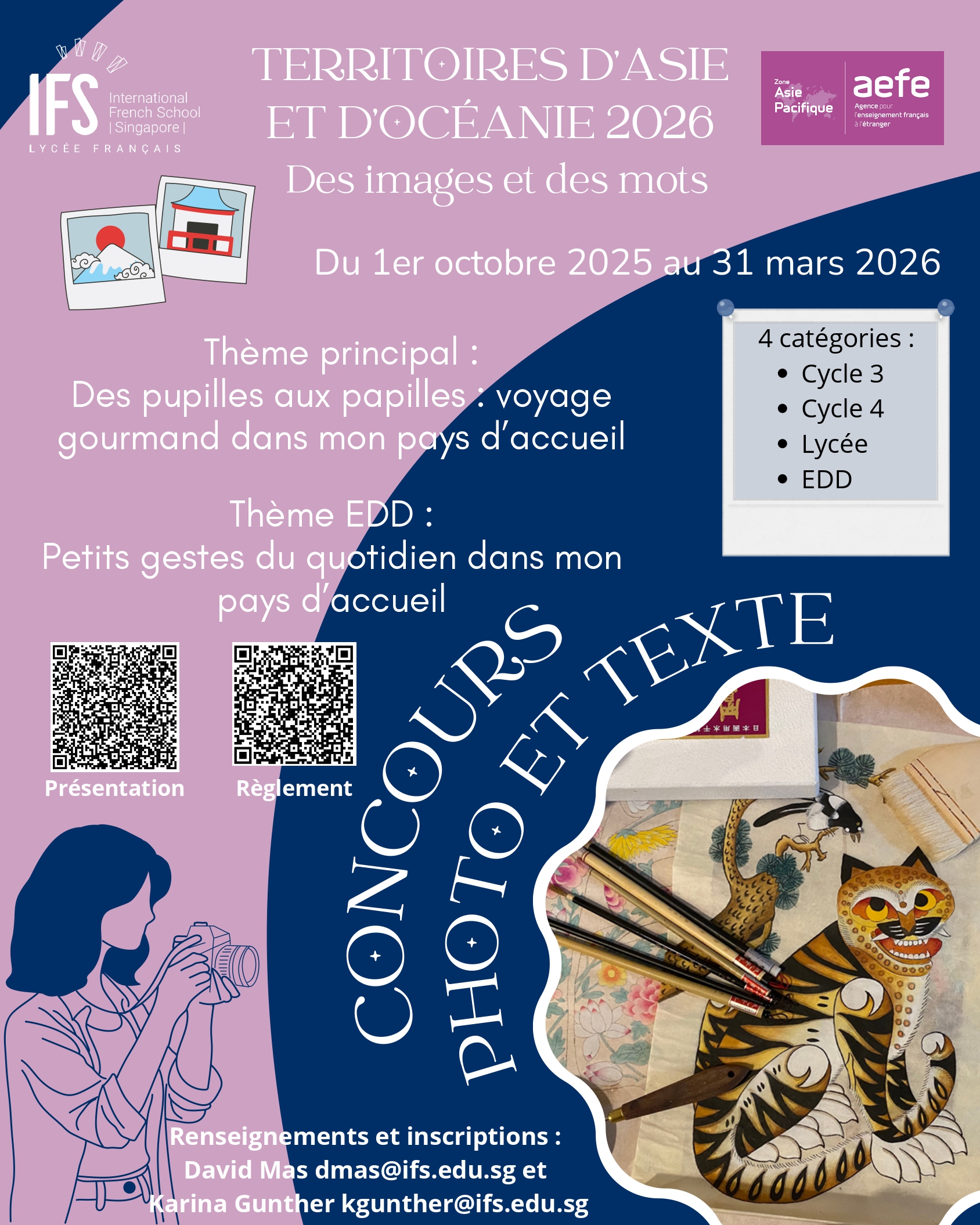
The Territories of Asia & Oceania contest invites students to rediscover their host country through photography and multilingual storytelling. This initiative encourages students to observe their surroundings and reflect on the cultural richness of their everyday lives.
Managed by the International French School of Singapore (IFS) since 2022 on behalf of the AEFE Asia-Pacific and Oceania network, the contest connects schools across the region through a shared artistic project.
How to Participate
Students are invited to submit a photograph of a place, person, or meaningful moment, accompanied by a caption that explains the story behind the image.
Discover this year’s winners across all categories:
For full details and submission guidelines, please visit the official website:
Territoires D'Asie 2026 Winners
THIS YEAR’S THEMES
CONTACT INFORMATION
General Enquiries
Cathy Graniczny, EMFE Singapore
[email protected]
Prize Reimbursement & Finance-Related Enquiries
[email protected]
WHO CAN PARTICIPATE?
The contest is open to all students from CM1 to Terminale (Grades 4–12).
Entries may be individual or class projects, divided into three categories:
- Cycle 3
- Cycle 4
- High School (Lycée)
SUBMISSION GUIDELINES
REGISTRATION & EVALUATION CRITERIA
Entries will be judged according to the following criteria:
- Schools wishing to participate must register before January 12, 2026 by emailing [email protected].
- A ProZap participation fee of €100 per school helps support the project’s organization. Payment details will be provided upon receipt of invoice.
- The final entries must be sent before March 31, 2026 in Word format to [email protected]
- Relevance to the theme: The photo and caption must clearly reflect the chosen theme.
- Photographic quality: Technical and artistic merit of the image.
- Caption originality and relevance: The caption should explain or illustrate the photographer’s choice.
- Bilingual presentation: The caption must be written in French or English and translated into the local language (or a language studied at school).